Steef suspended and investigated over incriminating photographs and the boy's death
Nieuwe burenSteef’s suspension and investigation over photographs and a boy’s death transform a chain of uncertain evidence into a crisis of trust for Eva and Peter. The discovery of the body makes Steef’s earlier pursuit of a boy with a gun seem potentially fatal; later, however, the manner of death, the limits of the evidence, and the arrest of another suspect unsettle that conclusion without making Steef’s conduct seem unproblematic.
Background and the First Accusations
The investigation enters the story through Eva, who tells Peter that photographs from their website are at the police station and that Steef has been suspended. At first, Peter reacts with relief. He assumes that the photographs, which show Steef and Rebecca, cannot by themselves justify a serious accusation: appearing on the internet is not illegal. Eva then adds a more alarming allegation: Steef is also accused of having handled a boy too roughly.
The accusation acquires a different weight when Eva tells Peter that the boy’s body has been found in a ditch beside the A9. Peter connects the news to the boy in a baseball cap and to his earlier memory of Steef with a pistol tucked into his jeans. The evidence does not yet establish that Steef killed the boy, but the coincidence of the boy, the weapon, and the discovery of a body makes suspicion immediate. Peter’s thought that the potential father of his child may be a murderer shows how quickly the investigation reaches beyond Steef’s employment and into the couple’s private future.
Evidence, Suspicion, and Competing Accounts
The photographs are not the only material drawing attention to Steef. In a later account, Steef explains that the boy was strangled, not shot, and that it is uncertain whether the dead boy was the same person who had threatened him. He says the investigators found photographs of him and Rebecca on the boy’s computer. They also received an anonymous call from a neighbor who said Steef had chased a boy with a pistol and believed the boy to be the one involved in the earlier incident.
These details narrow and complicate the accusation at once. The discovery of photographs on the boy’s computer creates a connection between him and Steef, while the anonymous report supplies a possible account of Steef’s pursuit. But neither fact, as Steef presents it, proves that he caused the death. The distinction between being connected to a dead boy, pursuing someone while armed, and killing him matters: the investigation raises questions about both the death and Steef’s conduct, without initially resolving either.
The Personal Cost of the Investigation
Eva delivers the news while distressed. Her fingers are cold as she reaches for Peter’s hand, and tears streak her mascara when she tells him about the accusation and the body. Peter hears the information not as detached reporting but as a threat to the fragile possibility of a child. His alarm is also entangled with the couple’s existing grief: he has described their lives as having found a new balance after losing Lieve, even as reminders of that loss continue to reopen it. The prospect of a child therefore carries hope and fear together, and the investigation puts a frightening identity on the man who may be connected to that hope.
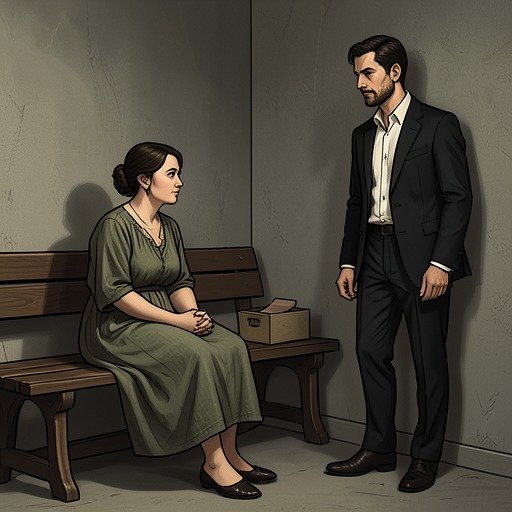
In another scene, Peter and Steef arrive at a house where Eva and Rebecca are sitting in the kitchen, subdued and looking at the floor. Rebecca cries; Steef says he is sorry. Eva takes Peter aside and tells him that Steef has been suspended and that he is thought to have killed a boy. She holds her arms over her abdomen and stares at the dark television screen rather than looking at Peter. Peter interprets her avoidance as evidence that she has deceived him, and dismisses the murder allegation as an attempt to intimidate him. His response shows that the investigation no longer operates only as a question of what happened to the boy: it intensifies his suspicion of Eva and his sense that others are trying to manipulate him.
Reversal and Significance
The apparent case against Steef is later revised. When Peter threatens to tell Steef’s colleagues that he pursued the boy with a gun, Steef laughs and says he did not kill him. He tells Peter that the actual perpetrator was arrested that afternoon and that he is no longer suspected. Peter still objects that an officer should not have pursued someone with a weapon while off duty. The arrest therefore resolves the central suspicion of murder but does not erase the troubling conduct that helped make the accusation plausible.
The event’s force lies in that distinction. Photographs, an anonymous report, and a body found beside a major road initially converge into a story in which Steef appears guilty; subsequent information separates the evidence of association and armed pursuit from responsibility for the killing. For Peter, the delay before that clarification allows the accusation to become bound up with his fear for the child and his distrust of Eva. The eventual release from suspicion changes what he believes about the death, but it cannot simply reverse the damage done while the evidence remained uncertain.